
Research experience
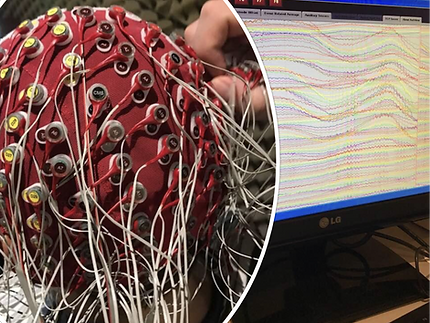
Electroencephalography (EEG)
-
Acquisition of EEG data (64 and 128 channel EEG).
-
Ability to assist with movement of participants and testing equipment.
-
Ability to recognize specific abnormal EEG patterns related to aging and dementia.
-
Preprocessing/processing of EEG data using MATLAB.
-
Analysis of evoked Potentials (endogenous and exogenous) in young/old adults and dementia patients.
-
Spectral analysis in young and old adults.
-
Analysis of EEG connectivity in young and old adults.
-
Analysis of alpha wave during both eyes closed and eyes opened condition in young/old adults and dementia patients. Alpha reactivity analysis.

Magnetic Resonance Imaging
(MRI)
-
Acquisition of MRI data. Safety: Level 1 user.
-
Ability to assist with participant screening prior to exams (metal objects, MRI safety)
-
Interview participants to explain MRI protocols and procedures.
-
Preprocessing/processing of MRI data using MRIcron, SPM12, CAT12, FSL, FreeSurfer
-
Analysis of Voxel-based morphometry (VBM).
-
Analysis of cortical thickness, gyrification.
-
Diffusion tensor imaging (DTI).
Neuropsychology
-
Interview participants to obtain comprehensive medical histories.
-
Identify and communicate risks associated with specific procedures related to the experimental protocol.
-
Conduct neuropsychological evaluations for research purposes. This includes assessments of attention, concentration, language, learning, and memory.
-
Data analysis of neuropsychological variables using varied statistics and machine learning.
Language of evaluations, analysis, and data report: English and Spanish.
Biological samples
-
Collection, labelling and storage of urine, blood, and saliva samples for research purposes.
-
blood processing.
-
urine aliquoting.
-
Data analysis of sex hormones and genotypes
Statistics, machine learning and programming
-
Extraction and analysis of raw data.
-
Data cleaning, and quality evaluations.
-
Advanced level of Biostatistics with R.
-
Strong analytical problem-solving skills.
-
Ability to perform basic and complex statistical analysis using R and MATLAB: descriptive stats, univariate models, multivariate models, factorial analyses, machine learning, AI.
-
Creation of graphs, charts, and tables to report on results of statistical analysis.
-
Deep learning.